
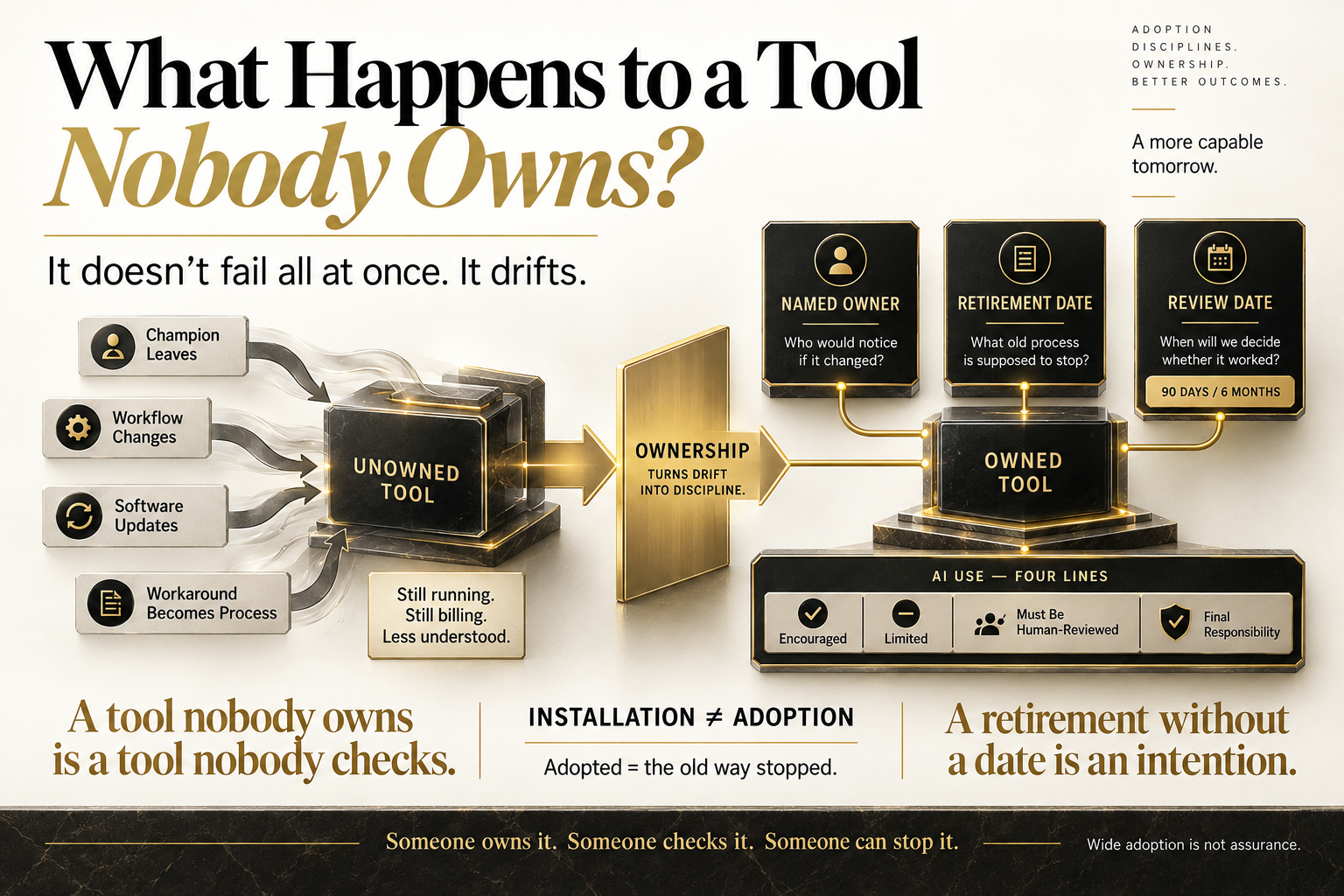
What Happens to a Tool Nobody Owns?
Tools do not fail dramatically. They drift. A named owner, a dated retirement and a review in the calendar prevent almost all of it.

What Question Makes a Vendor Uncomfortable?
Seven polite questions that separate a company with results from a company with a story. The reaction tells you as much as the answer.

Is This Tool Solving Your Problem or Someone Else's?
A tool can work perfectly and still solve someone else's problem. Write your constraint in one sentence first, and the evaluation gets easy.

What Should You Never Hand to a Machine?
AI made prediction cheap, which made judgment expensive. Four kinds of decision that should never cross the line, and how to tell.

Which of Your Tools Was Actually Tested, and Which Was Just Sold?
Your software stack is the honest record of how your business decides. Ten questions that show you what you are carrying and what it costs.

How Do You Tell Real Technology From a Good Story?
Every technology arrives twice. First as a story, and much later as a thing that either works in your building or does not. Telling the two apart is a leadership skill, not a technical one. The question is never whether a technology is real. It is what the technology has been tested to do, who ran the test, and what they had at stake in the answer. The AI Alignment Filter™ runs that question in four steps: name the bottleneck, identify which kind of cognitive load the tool addresses, count the true cost of integration, and decide whether the tool replaces judgment or enhances it. Before any of that, establish one thing. Are you looking at a regulated technology that a disinterested third party has examined, or at software that someone is selling you? Both can be excellent. They demand entirely different questions.